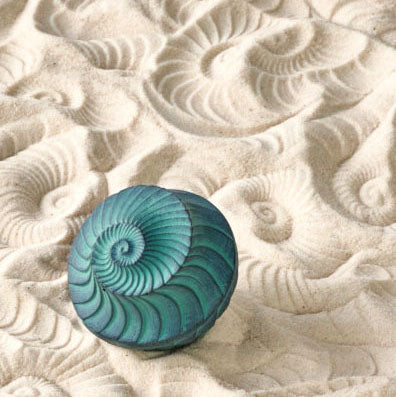
Made by hand in Portland, Oregon

How Olander Makes Wonderscapes and Sand Spheres

Every Wonderscape begins in Andrew Lonnquist's hands. He hand-carves the original designs that are reproduced through molds. The Portland studio then casts and finishes Olander's concrete Sand Spheres and forms, and pairs them with fine sand and wooden trays.

Follow the main stages behind the tactile art objects Olander has made since 2008.

Watch the studio process
Finished Olander Wonderscape with a wooden tray, fine sand, and concrete forms

Original designs, made in small batches

From hand-carved pattern to tactile art object

Andrew develops each pattern by hand, beginning with an original carving in a softer material. The studio uses those originals to make molds, casts the concrete forms in small batches, and finishes each piece by hand.

For Wonderscapes, Olander pairs the forms with fine sand and a wooden tray shaped with help from a local production partner and finished in the Portland studio. Meet the people behind the work on our About Us page.

Inside the studio

Watch the process take shape

This short studio film offers a closer look at the hands, tools, and practice behind Olander's original designs and concrete forms.

Five stages

How an original Olander design becomes a Wonderscape

The studio moves each piece through original carving, mold-making, small-batch concrete casting, hand finishing, tray preparation, and final assembly.

Finished Swirls Sand Sphere in patterned sand at left; Andrew carving the Petals original at right
Left: a finished Swirls Sand Sphere in sand. Right: Andrew carves the Petals original before mold-making. These are two designs at different stages.
Andrew hand-carving the light-colored Petals original before mold-making
Andrew carves the Petals original. The finished concrete Sand Sphere is cast later from a mold.

Original design

Andrew maps and carves the first pattern

Andrew Lonnquist develops each form by considering how it will feel in the hand and what kind of mark it will make in sand. Nature, science, and mathematics have informed his original patterns. He maps the design and hand-carves it in a softer material, refining the surface before mold-making. The photograph shows the Petals original in progress.

Olander studio team member working with molds for concrete Sand Spheres
A studio team member works with molds; the carved original is reproduced through casting.

Mold-making

The original becomes a mold for casting

Once the carved pattern is ready, the studio makes a mold that preserves its surface and shape. That mold allows the original design to be produced as a concrete Sand Sphere or form in small batches.

Andrew Lonnquist holding a finished Olander Sand Sphere
Andrew holds a finished cast concrete Sand Sphere. The concrete itself was not hand-carved.

Concrete casting and finishing

Each form is cast and finished by hand

The studio casts concrete forms in small batches, then checks and finishes each piece by hand. Sanding and color work can be part of this stage. Concrete gives the forms weight and carries the original carved texture into fine sand. Small surface and color variations come from the material and hand finishing.

Finished Olander wooden Wonderscape tray with fine sand and concrete forms
A finished wooden tray holds fine sand and concrete forms; the cutting and studio finishing stages are not shown.

Wooden trays

A local partner helps shape each tray

A local production partner cuts the wooden tray components. Olander then routes, sands, and finishes the trays in its Portland studio, preparing a smooth surface and balanced frame for the sand.

A finished Olander Wonderscape with a wooden tray, fine sand, and concrete forms
A complete Wonderscape shows the tray, sand, and forms together.

Final assembly

The pieces come together as a Wonderscape

Olander brings together a finished tray, fine sand, and original concrete forms in a Wonderscape. A person can roll, press, or guide a form through the sand, then smooth the surface and start again.

Inside an Olander packing box

These photos show the wrap around a piece, the cushioning inside a box, and the printed tissue and card on top.

Hand holding honeycomb paper around an object above a cardboard box
Honeycomb paper around one wrapped piece.
Two wrapped objects cushioned with crumpled paper in a cardboard box
Crumpled paper surrounds the wrapped pieces.
Printed sphere-pattern tissue and a Play Well card inside a cardboard box
Printed tissue and a Play Well card cover the packed contents.

Explore the finished work

See the pieces this process creates

Choose a complete Wonderscape, add concrete Sand Spheres and forms, or explore tray options for building your own arrangement.

Studio questions

Common questions about how Olander pieces are made

Are finished Sand Spheres carved from concrete?

No. Andrew hand-carves each original pattern in a softer material. The studio then makes a mold from that original and casts the finished Sand Spheres and forms in concrete.

Why does Olander use concrete?

Concrete gives each form a satisfying weight and preserves the carved surface well enough to make distinct impressions in fine sand.

How long does it take to make a Sand Sphere?

There is no single fixed production time. In 2020, Olander described some original designs taking Andrew up to 50 hours to carve. That was an example from earlier work, not a current order lead time. Casting and hand finishing add further stages; check the current product page for order timing.

Why does each piece look slightly different?

Olander casts and finishes the forms in small batches. Small differences in the concrete surface and hand finishing are part of the process, so each piece carries its own character.

Where are Olander trays made?

A local production partner cuts the wooden components. Olander then routes, sands, and finishes the trays in its Portland studio.