

The Therapy Room Report: What Practitioners Keep for Clients to Touch

79% of Therapists Say Clients Talk More Easily When They Can Fidget
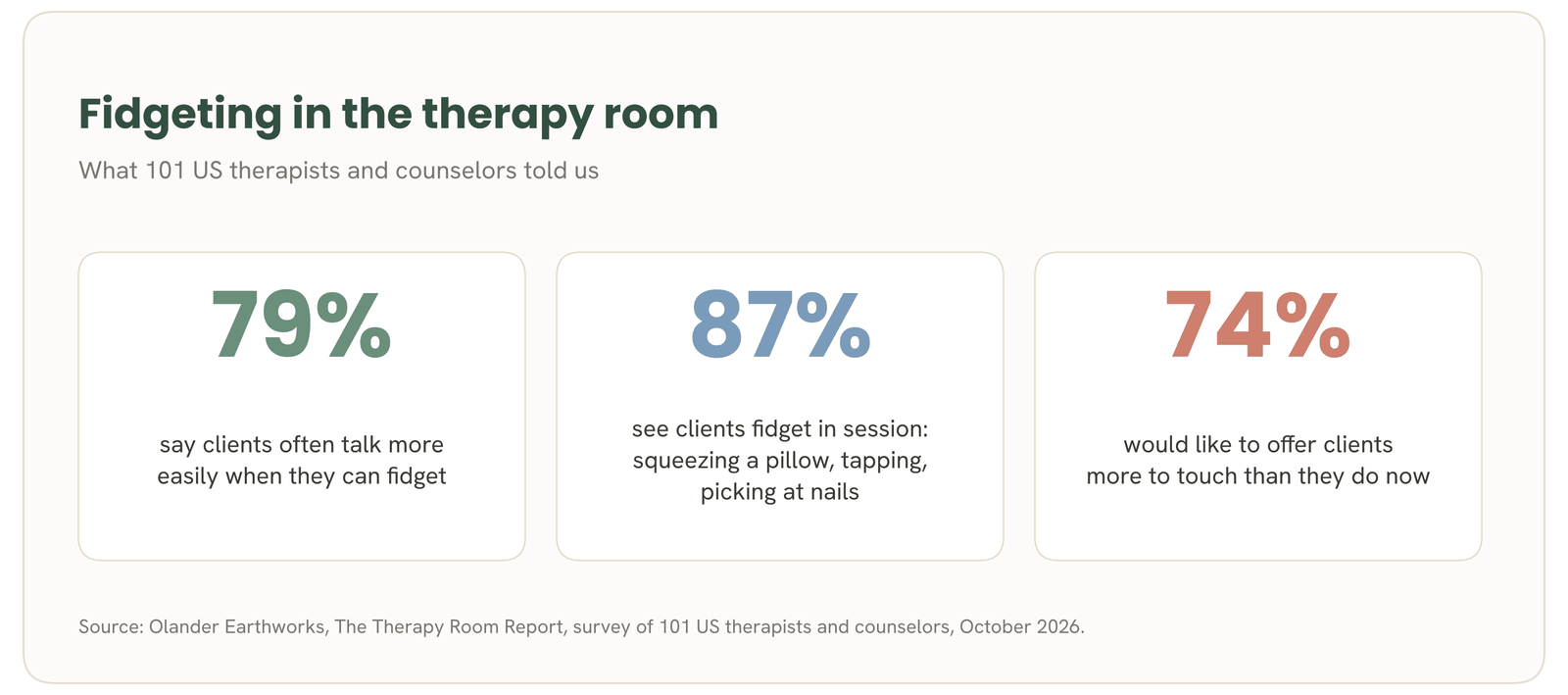
We asked 101 US therapists, counselors, social workers, and psychologists what they keep in the room where they see clients, and what clients do with their hands while they talk. 79 percent agree with the statement “Clients often talk more easily when their hands are busy.” Only 4 disagree.
Most of them already plan for it. 82% of practitioners who see clients in person keep fidget toys, stress balls, or putty in the room, more than any other kind of object. They see the habit for themselves, too: 87% see clients fidget in session. Clients squeeze a pillow, play with their hair, tap their fingers, or pick at a sleeve.
The same practitioners want more. 74% would like to offer clients more to touch than they do now. Asked to picture the room they would set up, they reached first for natural objects like stones and shells, a small tabletop sand tray, and clay. Space and cost are what stand in the way.
This report is for anyone who sets up a room where people talk about hard things: therapists and counselors, the practices and agencies they work in, and the people who design those spaces. It also gives researchers and writers a baseline on what sits in therapy rooms today and what practitioners would add.
Key Findings
What therapists and counselors told us
Eight findings from 101 US therapists and counselors. For writers and editors, each finding comes with its base and a source line.
For writers and editors: open the text under a card and click it once to select the whole thing, source line included.
79%
say clients often talk more easily when they can fidget
79% of US therapists and counselors surveyed agree that clients often talk more easily when their hands are busy. Only 4 disagree.
Text to copy
79% of US therapists and counselors surveyed agree that clients often talk more easily when their hands are busy. Only 4 disagree. (80 of 101 respondents.) Source: Olander Earthworks, The Therapy Room Report, survey of 101 US therapists and counselors, October 2026.
87%
see clients fidget in session
87% of US therapists and counselors surveyed see clients fidget in session. The most common habit is squeezing or fiddling with whatever is near, like a pillow or a tissue (55%).
Text to copy
87% of US therapists and counselors surveyed see clients fidget in session. The most common habit is squeezing or fiddling with whatever is near, like a pillow or a tissue (55%). (88 of 101 respondents.) Source: Olander Earthworks, The Therapy Room Report, survey of 101 US therapists and counselors, October 2026.
82%
keep fidget toys, stress balls, or putty in the room
Among US therapists and counselors surveyed who see clients in person, 82% keep fidget toys, stress balls, or putty in the room, the most common kind of object on the list. 67% keep soft things, like a pillow or a blanket.
Text to copy
Among US therapists and counselors surveyed who see clients in person, 82% keep fidget toys, stress balls, or putty in the room, the most common kind of object on the list. 67% keep soft things, like a pillow or a blanket. (81 of 99 who see clients in person.) Source: Olander Earthworks, The Therapy Room Report, survey of 101 US therapists and counselors, October 2026.
76%
say adult clients welcome something to touch
76% of US therapists and counselors surveyed say adult clients welcome something to touch in session. No one disagreed. Only 15% say objects for play belong mostly in work with children.
Text to copy
76% of US therapists and counselors surveyed say adult clients welcome something to touch in session. No one disagreed. Only 15% say objects for play belong mostly in work with children. (76 of 100 respondents.) Source: Olander Earthworks, The Therapy Room Report, survey of 101 US therapists and counselors, October 2026.
74%
would like to offer clients more to touch
74% of US therapists and counselors surveyed would like to offer more hands-on options than they do now. Among those who see only adults, it is 82%.
Text to copy
74% of US therapists and counselors surveyed would like to offer more hands-on options than they do now. Among those who see only adults, it is 82%. (75 of 101 respondents.) Source: Olander Earthworks, The Therapy Room Report, survey of 101 US therapists and counselors, October 2026.
29% to 64%
keep natural objects now, and would keep them in their ideal room
Natural objects such as stones, shells, or pieces of wood show the biggest jump from the therapy room practitioners have to the room they would set up. 39 practitioners want them and do not have them yet.
Text to copy
Natural objects such as stones, shells, or pieces of wood show the biggest jump from the therapy room practitioners have to the room they would set up. 39 practitioners want them and do not have them yet. (29 and 63 of 99 who see clients in person.) Source: Olander Earthworks, The Therapy Room Report, survey of 101 US therapists and counselors, October 2026.
11 to 38
practitioners keep a small tabletop sand tray now, and would keep one in their ideal room
The small tabletop sand tray any client can touch is the rarest object in therapy rooms today. 11 US therapists and counselors surveyed keep one, and 38 would put one in their ideal room.
Text to copy
The small tabletop sand tray any client can touch is the rarest object in therapy rooms today. 11 US therapists and counselors surveyed keep one, and 38 would put one in their ideal room. (99 who see clients in person.) Source: Olander Earthworks, The Therapy Room Report, survey of 101 US therapists and counselors, October 2026.
59% and 58%
name cost and space as what gets in the way
Cost (59%) and space (58%) are the most common reasons US therapists and counselors surveyed give for not offering more hands-on objects. Only 15% are unsure which objects would be useful.
Text to copy
Cost (59%) and space (58%) are the most common reasons US therapists and counselors surveyed give for not offering more hands-on objects. Only 15% are unsure which objects would be useful. (100 respondents.) Source: Olander Earthworks, The Therapy Room Report, survey of 101 US therapists and counselors, October 2026.
Who Ran This Study, and Who Responded
Olander Earthworks surveyed US practitioners through Prolific, an online research panel, in October 2026. Prolific limited the study to people whose job is in counseling, social work, psychology, or occupational therapy. 101 people completed the survey with successful attention checks.
Of the 101, 28 are licensed professional or mental health counselors, 22 are clinical social workers, 15 are counselors in training or supervised practice, and 16 are psychologists. The rest include 4 occupational therapists, 2 marriage and family therapists, 2 play therapists, and 8 who wrote in their role, such as a school-based therapist, a substance abuse counselor, and a peer support specialist.
75 work with adults, 41 with teens, 31 with children, 28 with couples or families, and 23 with older adults. Most see clients in person at least part of the week, and only 7 work all online. Ages run from 21 to 78, with a median of 36. Most are early or mid career: 69 of 101 have worked in their role less than ten years.
Clients Fidget While They Talk
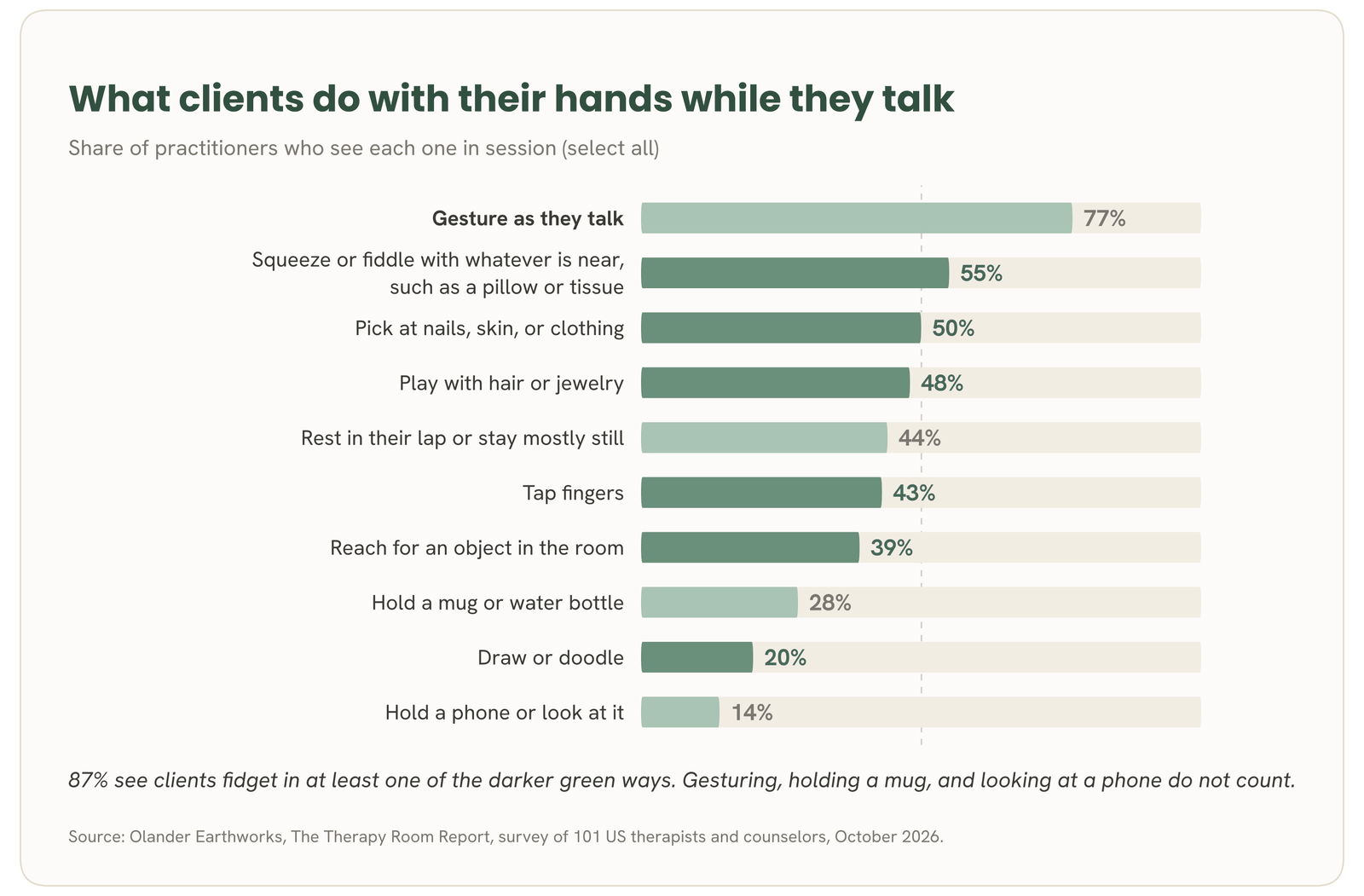
We gave practitioners a list of things clients' hands do in session and asked them to select each one they see. Several count as fidgeting: squeezing or fiddling with whatever is near, playing with hair or jewelry, tapping fingers, picking at nails, skin, or clothing, reaching for an object in the room, and drawing or doodling. Gesturing, holding a mug, and looking at a phone do not count.
From this perspective, 88 of 101 practitioners (87%) see clients fidget. Nearly half (49) see three or more of these habits. The most common is squeezing or fiddling with whatever is near, like a pillow or a tissue (55%). Picking at nails, skin, or clothing follows (50%), then playing with hair or jewelry (48%), tapping fingers (43%), and reaching for an object in the room (39%).
The habit shows up with every age group: 80% of practitioners who see only adults see it, and 94% of those who see children or teens. 44% also see clients who sit still.
The data demonstrates that, although there are patterns, an individual's response to therapy is individual and unique.
Most Practitioners Say Fidgeting Helps Clients Talk
We asked how much practitioners agree with the statement “Clients often talk more easily when their hands are busy.” 79% agree, including 16% who agree strongly. 4% disagree.
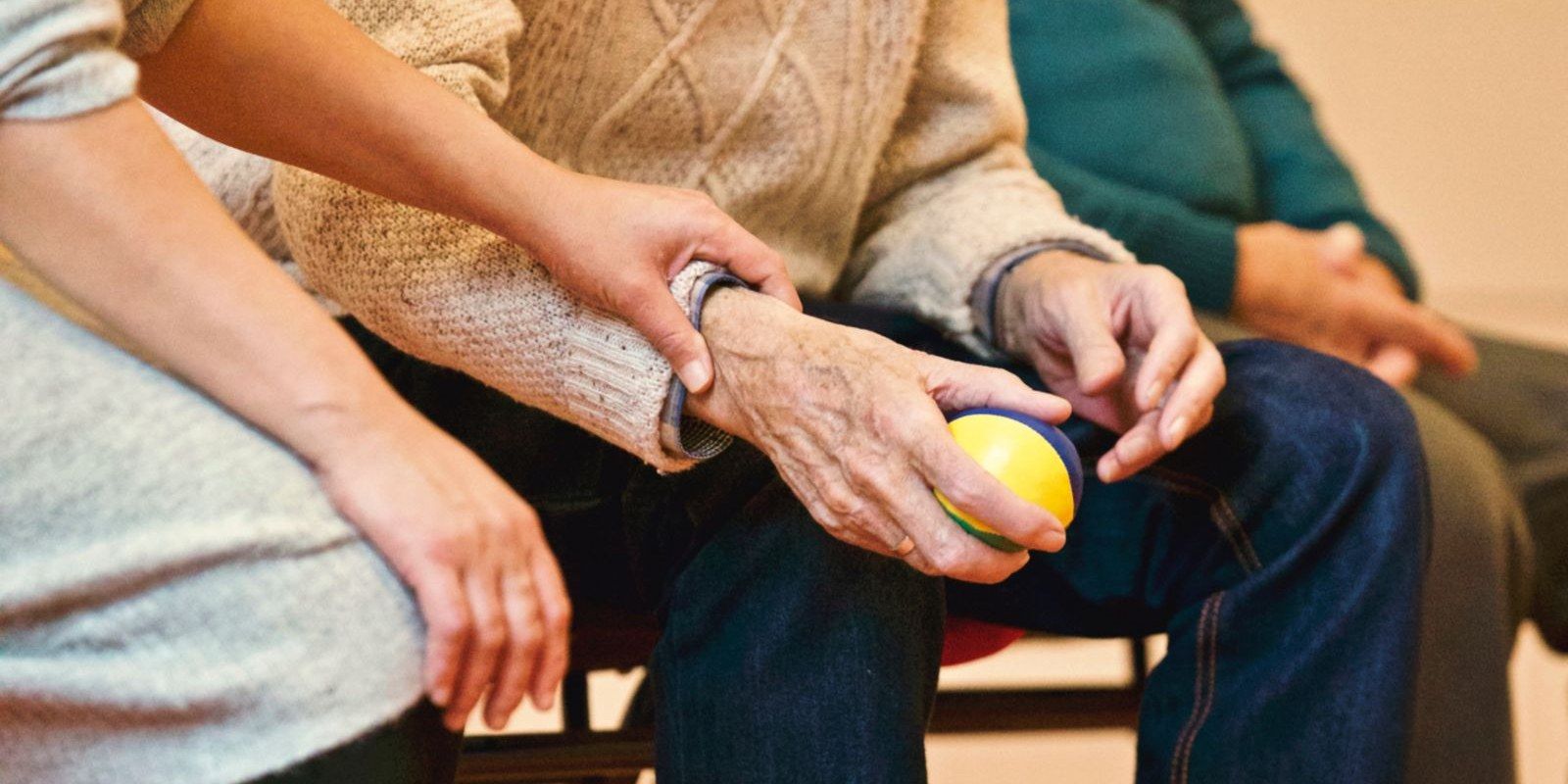
The practitioners who keep fidgets in the room see the most consistency in usage. Having access to fidgets in the office can allow continued reflection and deeper conversations. Among the 81 who keep fidgets in office, 73 agree. The view is strongest among practitioners who see children or teens (92%). It reaches well past that group, though: close to two in three practitioners who see only adults (66%) agree.
In our study, therapists and practitioners freely shared on the importance of fidgets and similar in-office tools. The survey opened with one written question, how practitioners decide what to keep in the room for clients to touch, before it showed any list that could cause bias. 65 of 101 named a fidget, a squishy toy, a stress ball, putty, or a sensory toy in their own words.
For a separate view of the same pattern, see Why a Simple Task Gets Adults Talking, an earlier Olander survey of 121 practitioners. There, 69% said clients talk more openly once a hands-on activity is underway. Like this report, it describes what practitioners observe and is not a test of an Olander product.
What Is in the Therapy Room Today
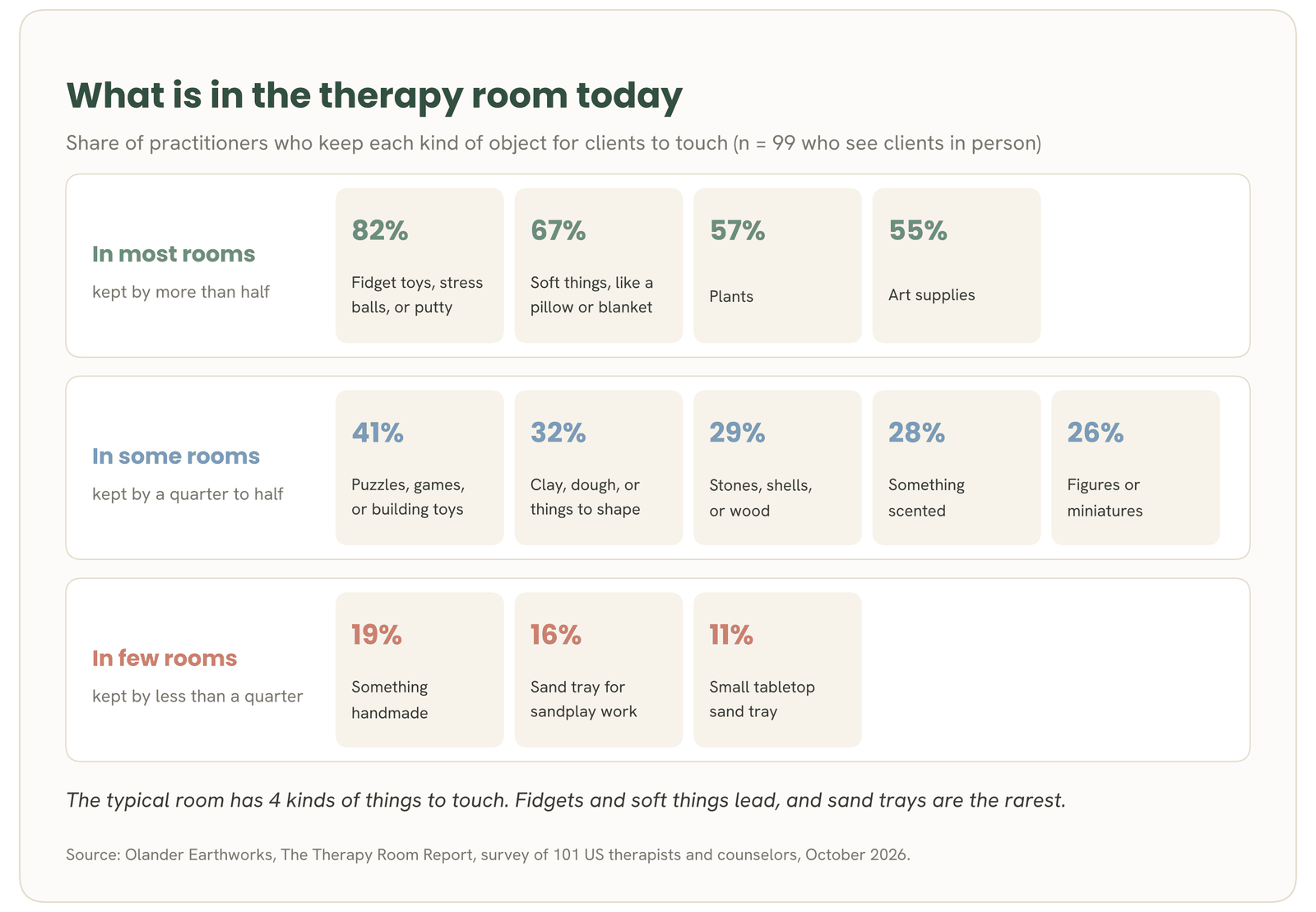
We asked practitioners which of twelve kinds of objects they keep in the room for clients to touch or use. Fidgets lead the list. Among the 99 who see clients in person, 82% keep fidget toys, stress balls, or putty. Soft things come next (67%), then plants (57%) and art supplies (55%). Those four types of objects occur in more than half of all rooms.
A second group of objects is popular for rooms as well: puzzles or games (41%), clay or dough (32%), stones, shells, or wood (29%), and something scented (28%). Sand trays are the rarest. 16 practitioners keep a sand tray for sandplay work, and 11 keep a small tabletop sand tray any client can touch.
Our study found that across respondents, the typical room has 4 kinds of interactive, tactile objects.
How Practitioners Decide, in Their Own Words
The opening question asked practitioners, in their own words, how they decide what to keep in the room. Five themes emerged.
Comfort first. Comfort came up most often (41 of 101). Practitioners wrote about calming nerves, easing anxiety, and helping clients settle in.
“I try to have a few items for holding, squeezing, and fidgeting to help with emotional processing and to help them feel comfortable.”
A licensed professional counselor who sees adults
Let the client choose. Practitioners wrote about variety, texture, and letting the client pick (25). Several keep a basket or a bowl of options and let clients reach for what feels right.
“I typically get 2 bowls with hard and soft squishies and let the client decide.”
A licensed professional counselor who sees older adults, teens and adults
Watch what they reach for. Some practitioners take their cue from the client. They pay attention to what clients pick up and what they ask for.
“I've had clients point out in previous positions when tissues or fidget toys were not available so I would want to make sure those were within reach.”
A psychologist who sees adults
Something to talk about. Some objects start a conversation (16). Practitioners described objects on a desk or a shelf that clients pick up and ask about.
“I have a dish that holds a lot of things I have found over the years, such as rocks, feathers, acorns, pinecones, and a star fish. Clients are curious and usually pick something up from in there and ask questions.”
A licensed substance abuse counselor who sees adults
Clean and quiet. A smaller group named cleaning and safety (15).
“Every item I have must be able to be disinfected. It must also not make much noise.”
A clinical social worker who sees adults
Rooms for Adults Have Less and Want More
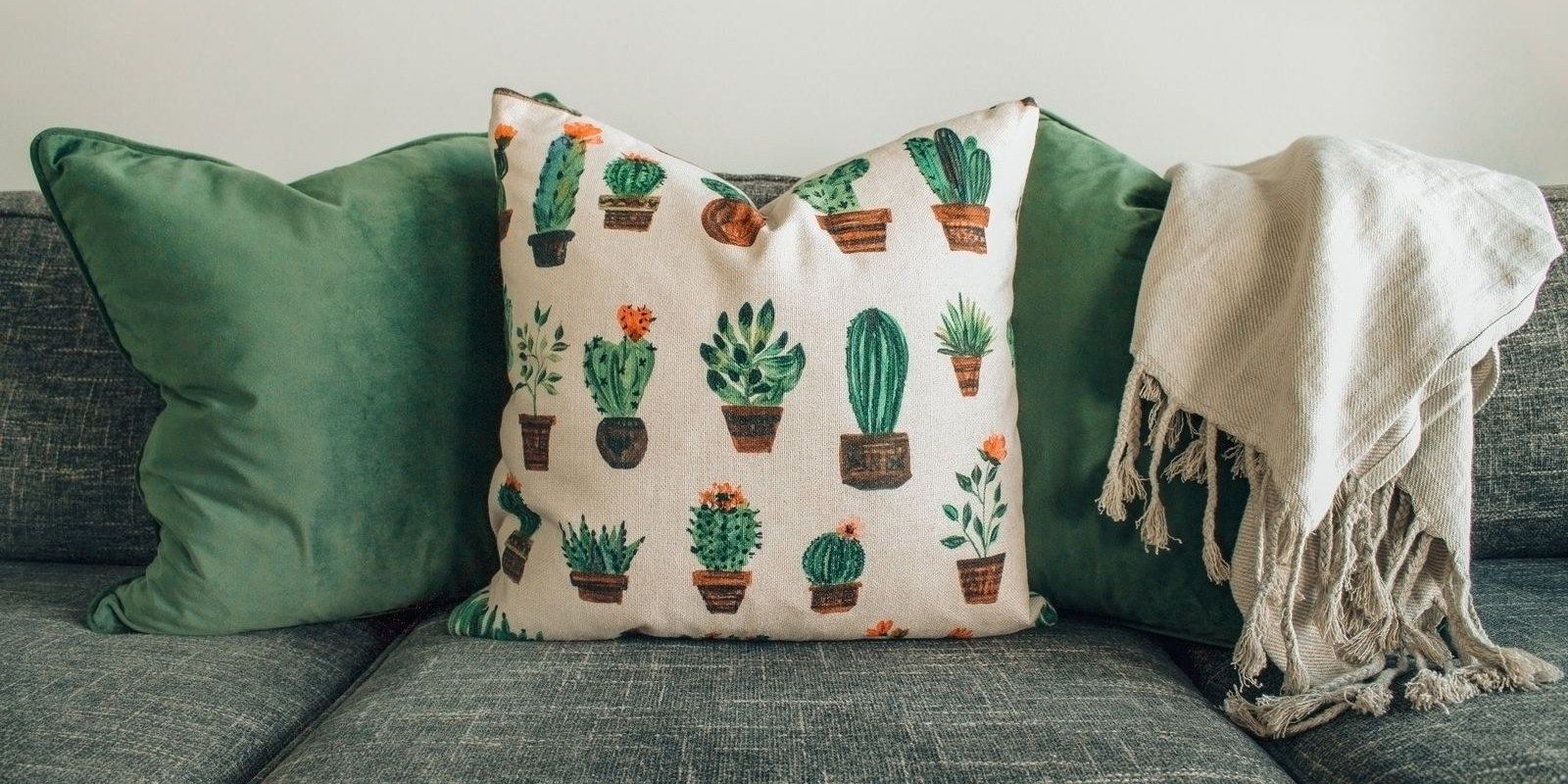
Adults have unique responses to items available in therapy rooms. 76% of practitioners say adult clients welcome something to touch in session. It is interesting to note that no one disagreed. Only 15% say objects for play belong mostly in work with children, and 65% disagree.
Rooms for adults start with less. 66% of practitioners who see only adults keep fidgets, next to 94% of those who see children or teens. Yet the adult group is the one most ready to add new items to their room: 82% would like to offer clients more to touch, next to 67% of those who see children or teens.
This suggests that adult therapy rooms are where the gap is widest between what practitioners want to offer clients versus what is available to them.
Natural Objects Top the Wish List
Next, we asked practitioners to picture the room they would set up if they could set it up any way they like, and to pick from the same list.
The ideal room is more interactive.
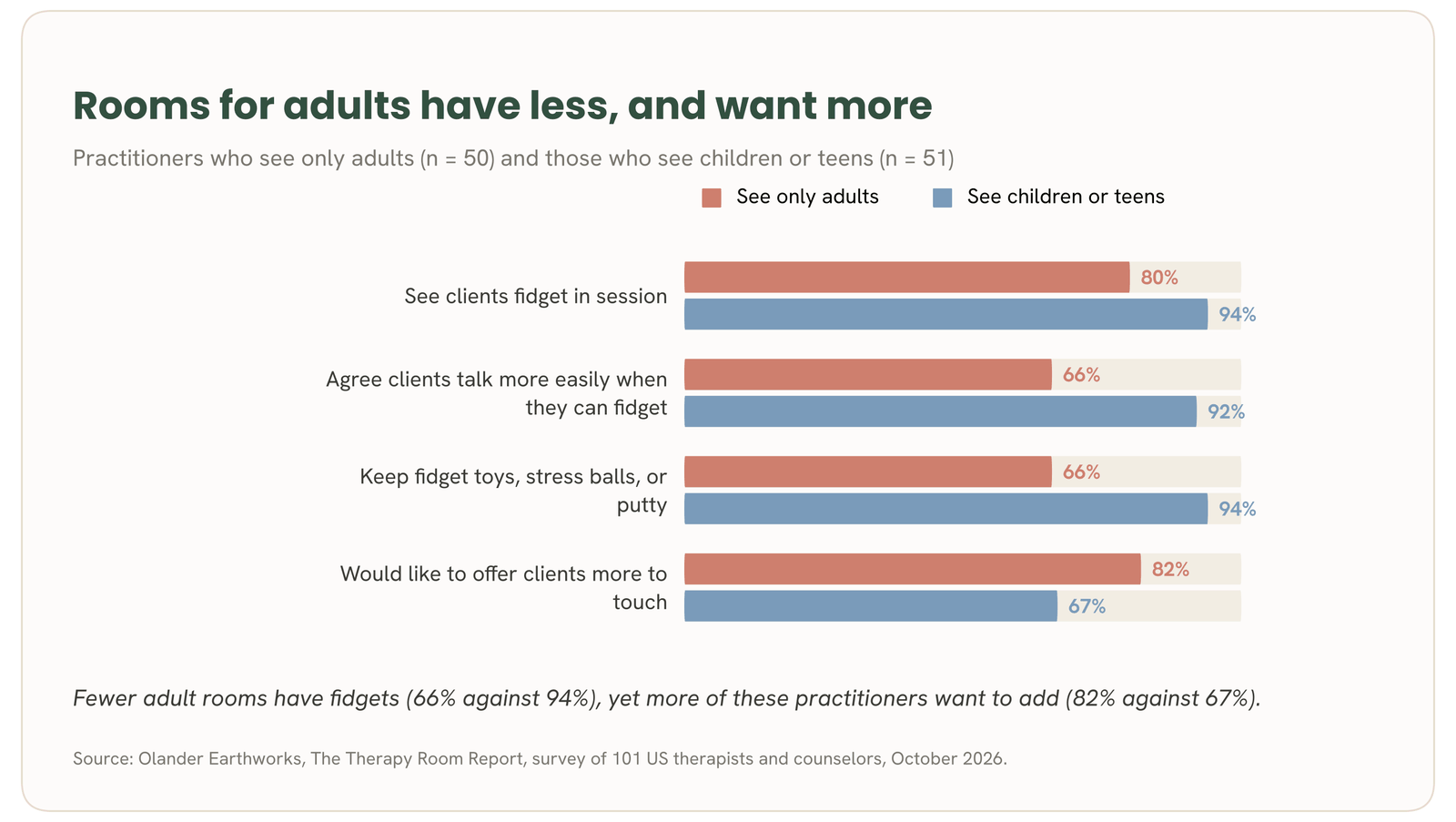
The typical practitioner keeps 4 kinds of things now and would keep 7. In the ideal room, they chose natural objects more often (from 29% to 64%), clay or dough (32% to 57%), plants (57% to 73%), something handmade (19% to 41%), and something scented (28% to 47%). Fidgets stayed level, since most rooms already have them.
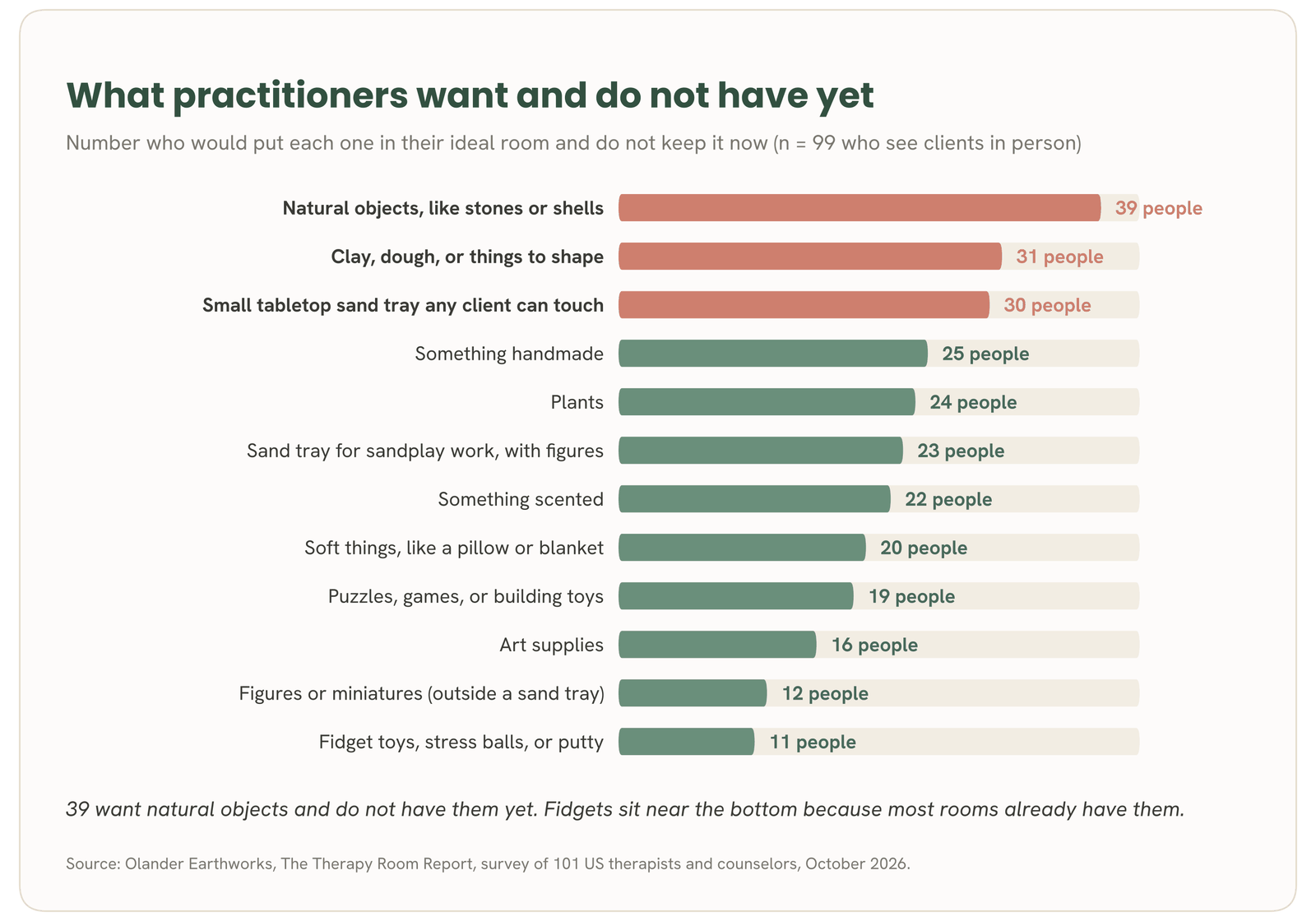
Natural objects show the biggest jump. 39 practitioners want stones, shells, or pieces of wood and do not have them yet.
The small tabletop sand tray shows the next biggest jump. 11 practitioners keep one now, and 38 would put one in their ideal room. That is three and a half times as many. It is the rarest thing on the list, and 30 of the 38 who want one do not have one yet. The sand tray for sandplay work, with figures, rose from 16 to 36. We kept these two apart in the survey because a tray any client can touch and a tray for sandplay offer separate functions.
An earlier Olander survey found the same wish. In What 104 Therapists and Allied Practitioners Said About Between-Session Follow-Through, an April 2026 survey, 54% of practitioners said they would recommend textured objects like smooth stones or ridged grips to clients, 21% would recommend sand trays, and 86% would recommend at least one kind of tactile object.
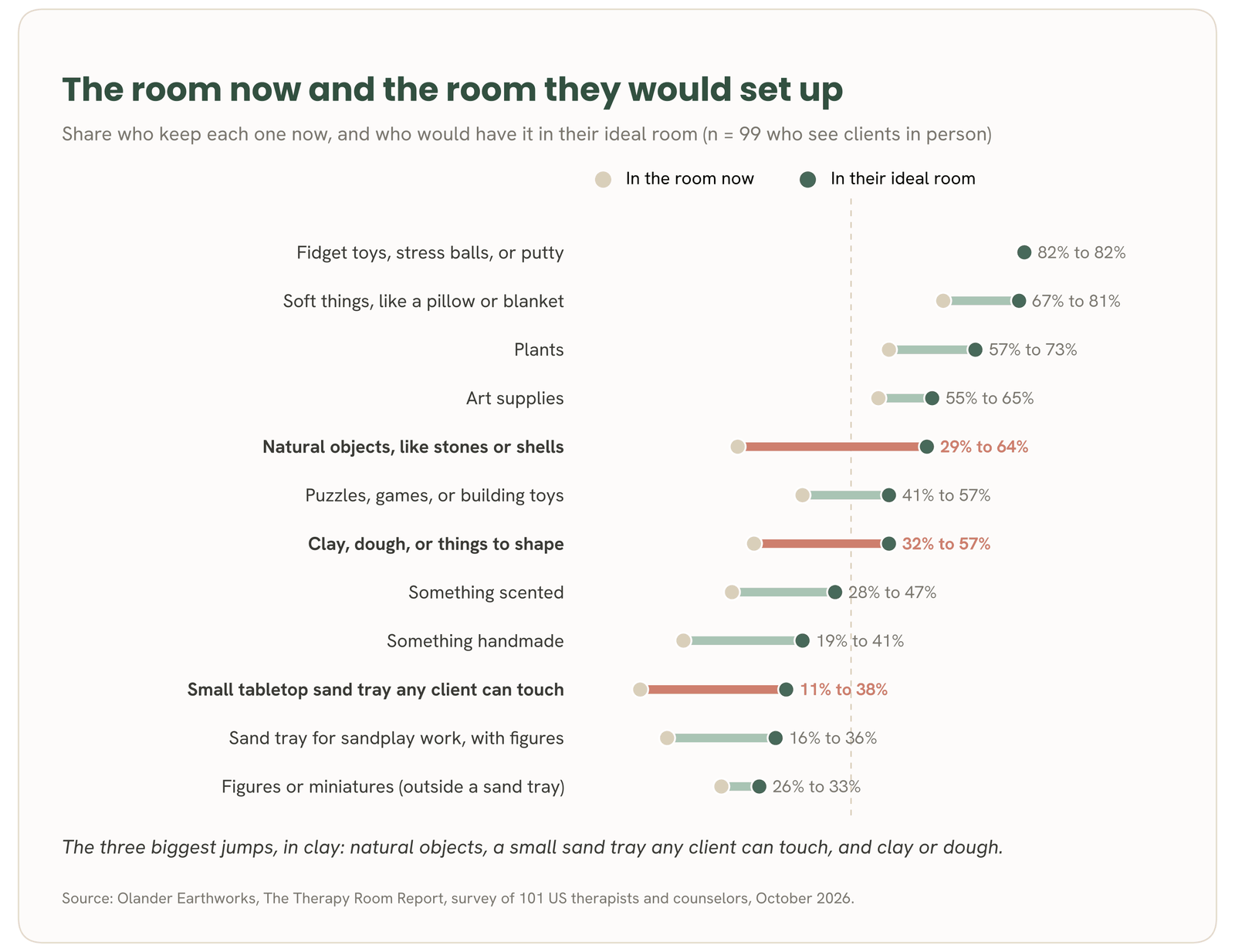
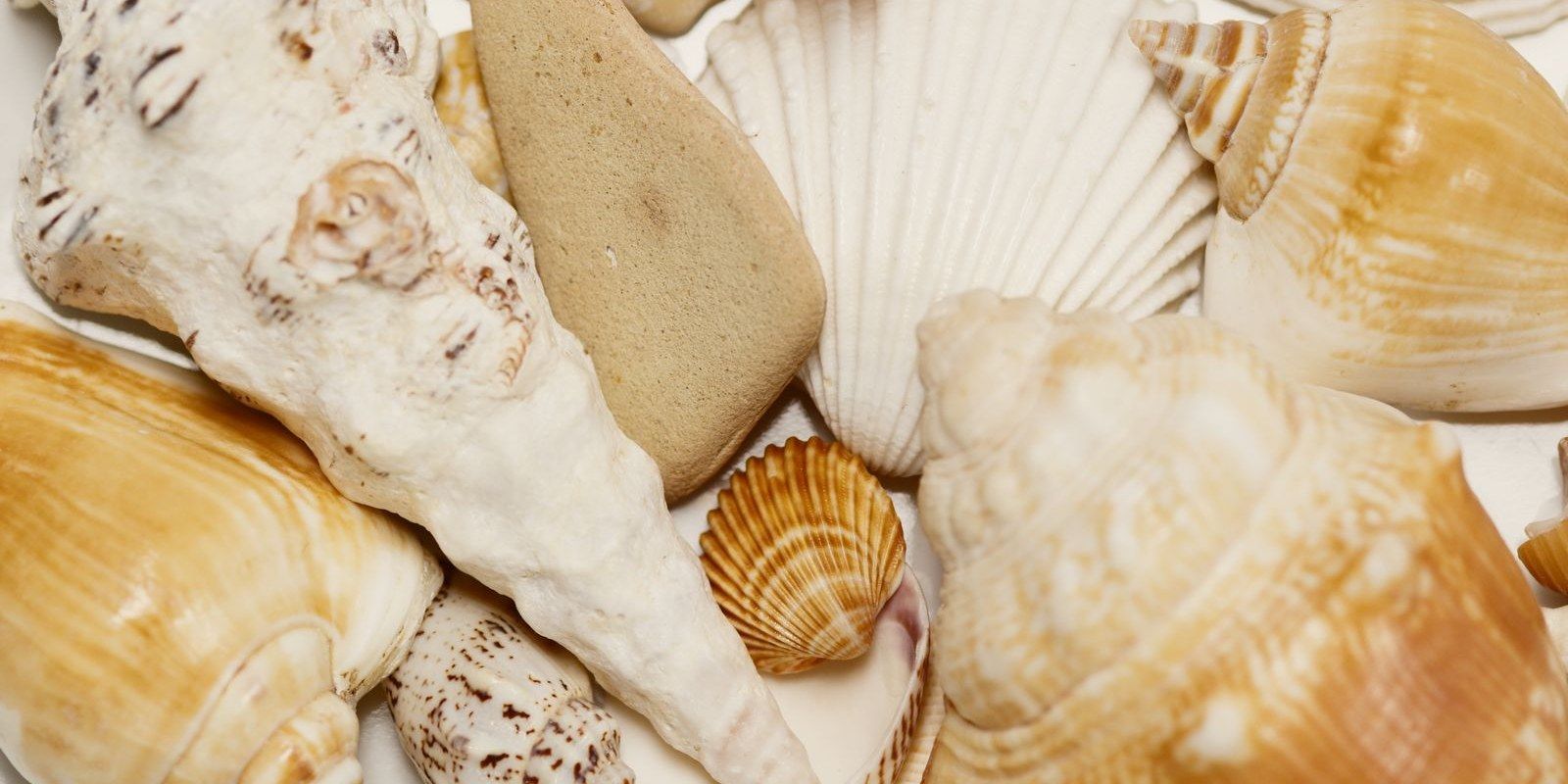
Several different types of items emerged when therapists considered interactive items in their ideal room. Natural objects lead with 39 people waiting. Clay comes next with 31, then the small sand tray with 30. Fidgets ranked nearly the bottom because many rooms already have them.
Something handmade more than doubled, from 19% to 41%.
Space and Cost Stand in the Way
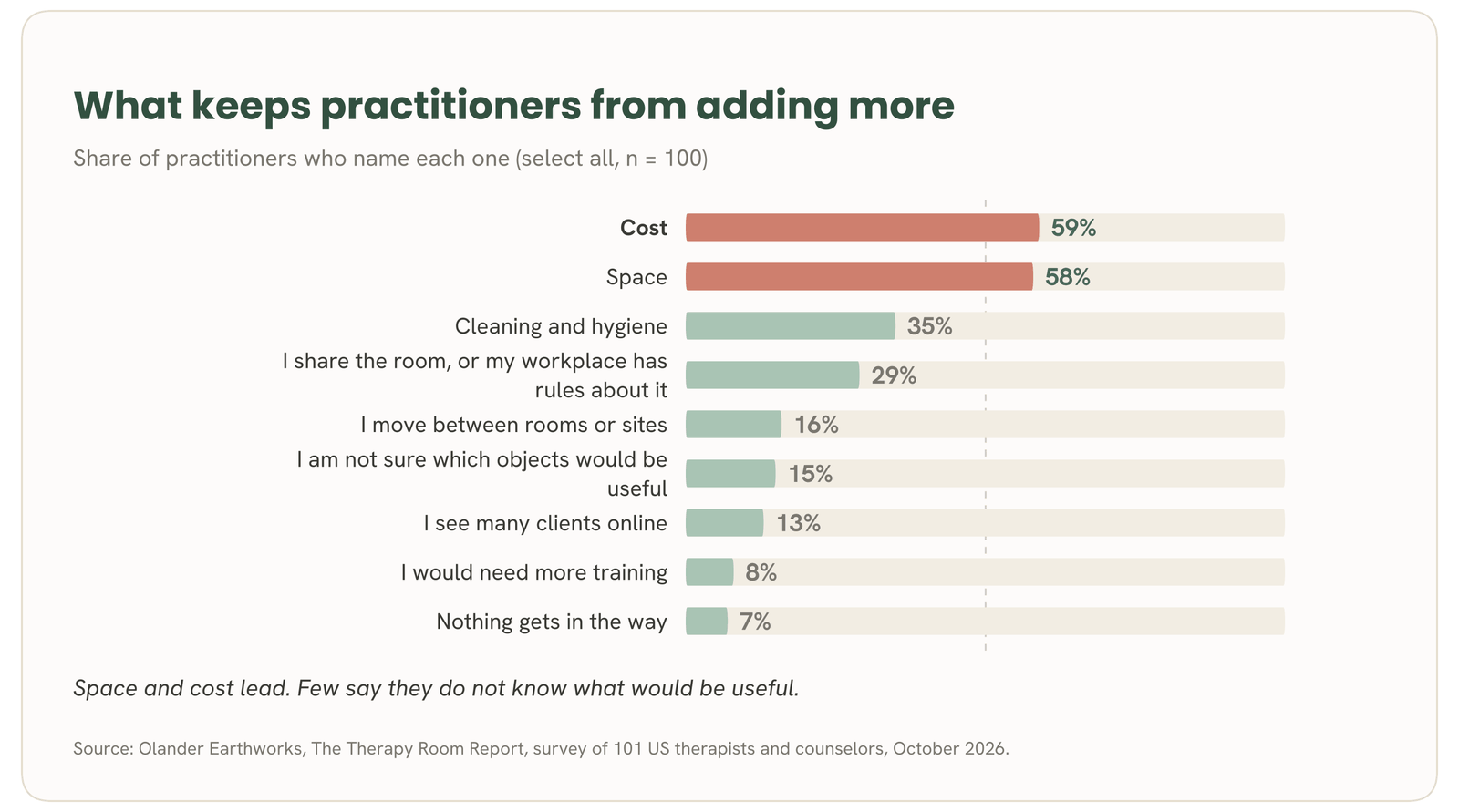
We asked what gets in the way of having more of these objects in the room. Cost leads (59%), with space close behind (58%). Cleaning and hygiene comes third (35%), then a shared room or workplace rules (29%). 16% move between rooms or sites, so what they use has to travel with them.
Among the 75 practitioners who want to offer more, 43 selected space and 47 selected cost. Knowing what to buy is a small barrier. Only 15% said they are unsure which objects would be useful, and 8% said they would need more training. Practitioners know what they want. The limits are the size of the room, the budget, and the rules of the place they work.
When a Client Gets Stuck
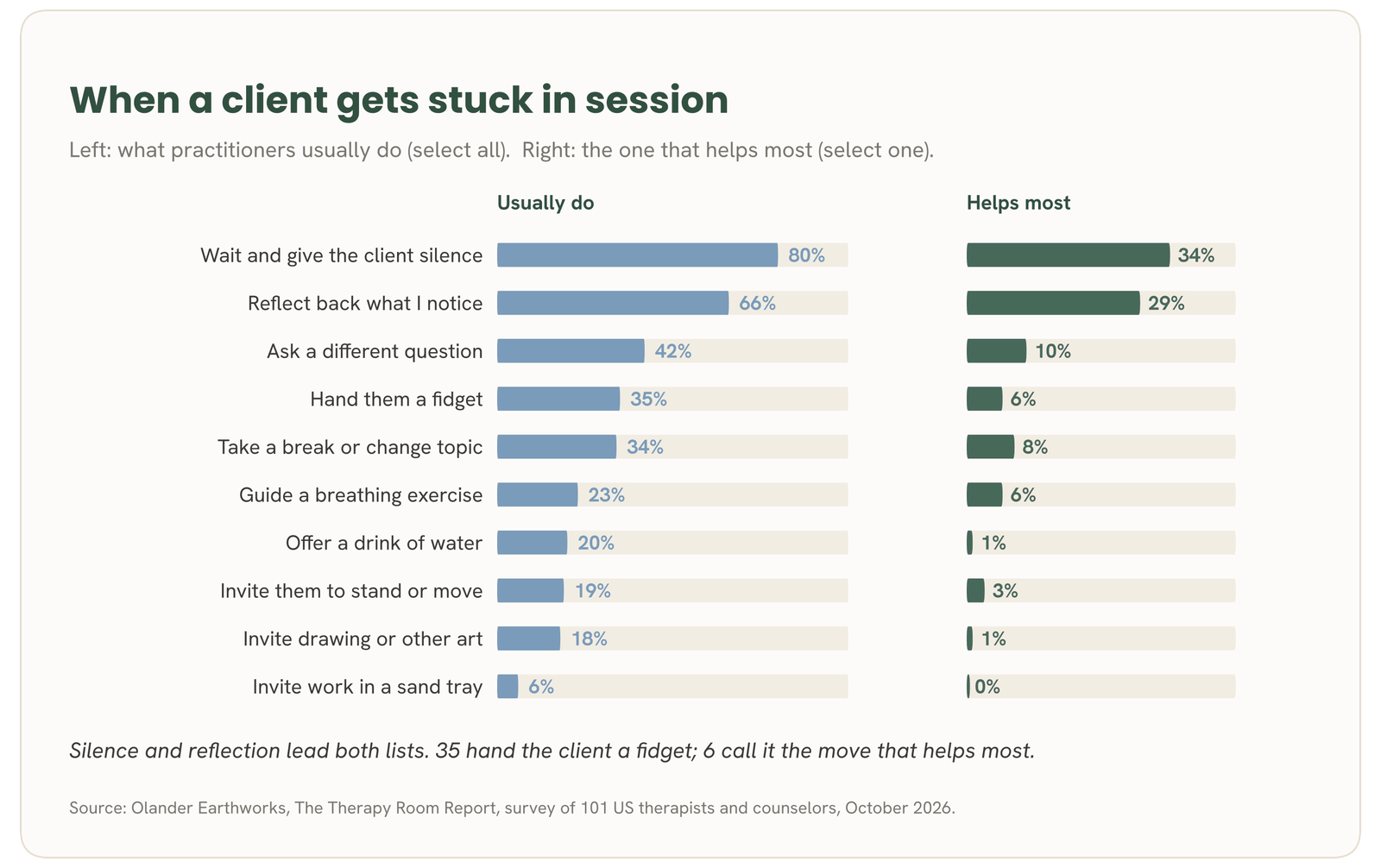
We asked what practitioners usually do when a client gets stuck in session, for example goes quiet, loses words, or shuts down. The most common approach is to wait and give the client silence (80%). Reflecting back what they notice comes next (66%), then asking a different question (42%).
Next, we asked for the one action that helps most. Silence leads (34%), with reflection close behind (29%).
Fidgets rank lower on both lists. 35% hand the client a fidget, putty, or a stone when a client gets stuck, and 6 call it the move that helps most. This suggests that practitioners use objects in the background of a session, where clients can reach them at any time, and use silence and words to move a stuck moment forward. Several practitioners wrote that the best move depends on the person.
“It depends largely on the client. Some work better with a redirect. Some need to sit in silence while they process the question.”
A licensed substance abuse counselor who sees adults
Sand in the Room
Throughout the study, we found that interaction with sand plays a significant role. 36 of 101 practitioners use sand in their work, and 25 of them see children or teens. Most work in a rectangle: 25 use a rectangle tray most, 7 use a round tray, and 4 use a square one. 6 invite work in a sand tray when a client gets stuck.
Choosing What to Keep in a Therapy Room: A Quick Reference
The data support a simple decision map for anyone setting up or adding to a therapy room. Start with who you see, then look at what limits the room, then set it up so clients can reach what they need.
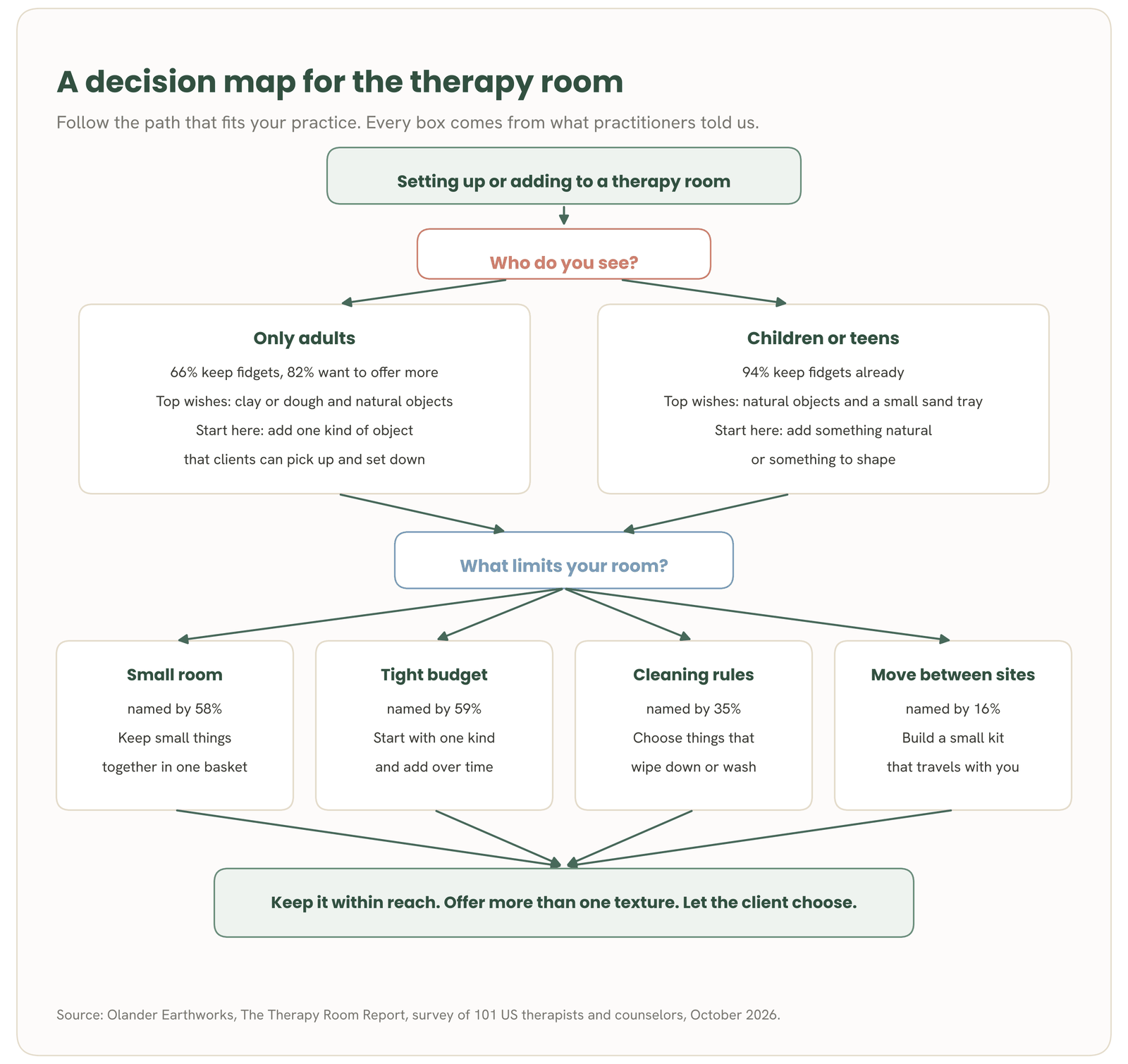
- Start with who you see. Practitioners who see only adults keep fewer objects and want more. Their top wishes are sand, clay or dough and natural objects. Practitioners who see children or teens already keep fidgets, soft things, and art supplies in most rooms, and their top wishes are natural objects and a small tabletop sand tray.
- Fit the room you have. Space is one of the two things named most often (58%), so small objects kept together in one basket fit most rooms. Cleaning came third, so choose things that wipe down or wash. If you move between rooms or sites, a small kit can travel with you.
- Keep it within reach. Practitioners told us about baskets and bowls on the table or next to the couch. When objects sit close, clients can pick something up without asking.
- Offer more than one texture. Soft, smooth, squishy, and firm came up again and again. The selection provides choice and agency, allowing each client find what works for them.
- Make room for natural objects. Stones, shells, and wood are the most wanted thing practitioners do not have yet (39 people).
Table 1
What practitioners keep now and what they would add
| Kind of object, as worded in the survey | Keep now | Ideal room | Want it and do not have it |
|---|---|---|---|
| Natural objects, such as stones, shells, or pieces of wood | 29% | 64% | 39 |
| Clay, dough, or other things to shape | 32% | 57% | 31 |
| A small tabletop sand tray or sand garden that any client can touch | 11% | 38% | 30 |
| Something handmade, by you or by someone else | 19% | 41% | 25 |
| Plants, real or artificial | 57% | 73% | 24 |
| A sand tray for sand tray or sandplay work, with figures or miniatures | 16% | 36% | 23 |
| Something scented, such as a candle or diffuser | 28% | 47% | 22 |
| Soft things, such as a pillow, plush toy, or weighted blanket | 67% | 81% | 20 |
| Puzzles, games, or building toys | 41% | 57% | 19 |
| Art supplies, such as paper, markers, or paint | 55% | 65% | 16 |
| Figures, miniatures, or dollhouse items, kept outside a sand tray | 26% | 33% | 12 |
| Something to keep hands busy, such as a fidget toy, stress ball, or putty | 82% | 82% | 11 |
Source: Olander Earthworks, The Therapy Room Report, survey of 101 US therapists and counselors, October 2026.
Conclusion
Fidgeting is part of how clients talk. 87% of practitioners see it in session, 79% agree that clients talk more easily when their hands are busy, and 65 of 101 brought up fidgets before we showed them a list. Most therapy rooms already plan for it with a basket of fidgets, a pillow, or a blanket.
Practitioners picture a fuller room, with natural objects, clay, plants, and a small sand tray any client can touch, and the typical practitioner would go from 4 kinds of things to 7. The gap is widest in rooms for adults, where fewer practitioners keep fidgets and more of them want to add. What stands in the way is practical: space, cost, cleaning, and the rules of a shared room.
For practices and agencies, the next step is small. Pick one kind of object from the wish list, keep it within reach, and watch what clients reach for.
How This Survey Was Conducted
We built the survey in Qualtrics and recruited through Prolific in October 2026. Prolific filters limited the study to adults in the United States whose current job is clinical psychologist, mental health counselor, occupational therapist, psychologist, or social worker. A later study and a direct link to the survey added a few more people. The survey opened with one written question before any list appeared. We lightly edited quotes for spelling.
This was an online-panel survey, not a nationally representative sample. The findings describe what practitioners reported, not measured changes in how clients talk or feel. They do not establish cause and effect and are not a test of Olander products.
Suggested Citation
Cite the report
Olander Earthworks. (2026). The Therapy Room Report: What Practitioners Keep for Clients to Touch. Published October 2026. https://www.olanderearthworks.com/blogs/research-studies-surveys/the-therapy-room-report-what-practitioners-keep-for-clients-to-touch
Citation to copy
Olander Earthworks. (2026). The Therapy Room Report: What Practitioners Keep for Clients to Touch. Published October 2026. https://www.olanderearthworks.com/blogs/research-studies-surveys/the-therapy-room-report-what-practitioners-keep-for-clients-to-touch
About Olander Earthworks
Olander Earthworks is a Portland, Oregon studio that has been making handcrafted tactile objects since 2008. Our Wonderscape sets, concrete Sand Spheres, and textured sand wonks are designed to engage the hands and quiet the mind.


