

What Is Sand Tray Therapy & How Are Wonderscapes Different?
Imagine a box of sand on a low table. A person kneels beside it. This image is where the sand tray therapy method begins.
Sand. A flat container, the right size to capture a full field of view. A cabinet of small things to put in it.
The method is approximately a century old, and it began with two European women. A century later, their practice is supported by literature, a base of researchers, and professional certifications. From the outside, the technique may seem small or simple. A person is playing in the sand with a practitioner watching. Yet, this technique has become a widely practiced method among clinicians worldwide, supported by professional societies and certification standards (International Society for Sandplay Therapy). This article provides an orientation to the method, including the tools and the founders. By the end, you will have a strong understanding of sand tray therapy techniques and practices over time.
This article is educational and does not provide mental health advice. Sand tray therapy and sandplay therapy are clinical practices led by trained practitioners. Wonderscapes are tactile art objects, not a substitute for therapy.
The Tray: The Technique’s Defining Object
The sand tray itself is an object of specificity and study.

The sand is fine and pale. Therapy-grade sand is typically described as angular and crystalline, so it holds the tracks a client's fingers make for an hour without change. The interior is blue. The dimensions are traditionally set so the tray matches an adult's field of vision when seated, a rationale associated with Dora Kalff's development of the method (Kalff 1980). Everything sits inside one field of view.
Look once, and the whole thing is there. The eye has no need to travel. The sand tray is a bounded surface that holds a unique world for the duration of the session.
The interior paint matters; the color does specific work. Sand pushed aside, the painted bottom shows through: river, lake, ocean. Sand mounded high against the walls: sky. The tray is designed as a tiny ecosystem, buildable, moldable, and functional.

The sand is fine and pale. The sizing must be between one hundred and fifty and two hundred and fifty microns. Therapy-grade sand is described as angular and crystalline. This type of sand holds the client’s tracks, made by their fingers, for an hour without change.
Many practitioners keep two types of sand, one wet and one dry. Each one carries a sensory feeling, and they offer different functions. Wet sand is for packing and building. Dry sand is for pouring and moving.
Reviewers of therapy-grade sand describe the feel in body-led, somatic terms: it feels like beach sand from the Gulf of Florida; it sparkles; the anxious person will just move their hands through it over and over. The last description captures the technique in one statement.
The World Technique, The First Practice
Picture a therapist’s office. A child arrives, age seven, brought by a parent who has tried everything. Margaret Lowenfeld greets them. She is known in the field for helping struggling children.
She points to a tray of sand on a low table and to a wooden box of small objects: animals, fences, tiny houses, and a few people. She says, "Make a world.”
The child begins.
Lowenfeld sits down in a low chair across the room and takes out a notebook. By the end of the hour, the child has built something unique, unseen before.
Margaret Lowenfeld trained as a pediatrician. She returned to London from Poland after the First World War, where she worked as an early-career doctor, treating typhus patients in the field. Her experiences changed how she viewed her next step.
By the late 1920s, she was working in central London with children who needed help. In 1928, she founded the Institute of Child Psychology in Notting Hill. Her working hypothesis: we operate from a level deeper than verbal language. If we can address this level, we will meet the true inner challenge.
From this premise came The World Technique. She began with small objects she had on hand, along with sand, a tray, and water. Her invitation each time was to make a world.
Sandplay, The Practice Transforms
Dora Kalff trained as a Jungian analyst in Zurich in the early 1950s with Emma and Carl Jung. Through her relationship with the Jungs, Kalff traveled to study with Lowenfeld. She brought back the World Technique, but transformed it with her own approach.
The Jungian approach from Kalff made a major change in the field. Kalff renamed the method Sandplay. Her central concept is that the tray is a space where the psyche can be expressed.

Kalff released Sandplay: A Psychotherapeutic Approach to the Psyche in 1980. Five years later, she and a group of practitioners she trained became the International Society for Sandplay Therapy.
The Field Continues On
Practitioners documented the work over the next decades, making refinements and applying it to specific populations.
Estelle Weinrib's Images of the Self (1983) gave English-language readers the first major synthesis of Kalff's method. Kay Bradway and Barbara McCoard's Sandplay: Silent Workshop of the Psyche (1997) became the standard Sandplay clinical text.
From the 2000s forward, practitioners expanded the method's reach. Linda Homeyer and Daniel Sweeney's Sandtray Therapy: A Practical Manual (third edition, 2017) is the standard generalist text. Practitioners adapted the method for trauma-focused work (Carey 2006), grief work (Boik and Goodwin 2000), group sandplay (De Domenico 1995), adult clients (Bradway 1985; Mitchell and Friedman 1994), couples and families (Carey 1991), and integration with EMDR, narrative therapy, and somatic approaches.
The approach is a chosen method for work with refugees, with veterans, with survivors of torture, with elementary-school children, with hospice patients, and with practitioners themselves, who often work their own sand tray during training and supervision.
The Materials & Technique Foundations
To understand the mechanisms, we look to materials in the technique. They include the tangible and the intangible, as defined by the field.
The materials include sand, a tray, and figures. Kalff describes the dual condition of the practice as free and protected space. The practitioner’s role is to be a witness. In the sand tray, the client finds a bounded surface where they can build a unique world. Building is defined as an act of construction here, which allows the client to mold and shape their sand tray world. Sequence is what the client builds over time through many sessions as a set of trays. In long-term work, the sequence is the central object of analysis.
Witnessing is its own kind of work. It is sustained attention that can take the practitioner years to develop. New practitioners may describe themselves as tired after a session due to the intensity of attention. Each of these elements, though simple, allows for a complex healing process to emerge.
How Are Wonderscapes Different?

Sand trays used in sand tray therapy have many defined characteristics specific to the practice. Here at Olander Earthworks, we make something else, akin to aspects of sand tray therapy but distinct in form, function, and feeling.
Wonderscapes are not created for traditional sand tray therapy. Wonderscapes use sand and sculptural forms, but they are not clinical sand tray therapy tools. After establishing the history and facts around an easily associated practice, we want to clarify the distinctions that make a Wonderscape special.
Form

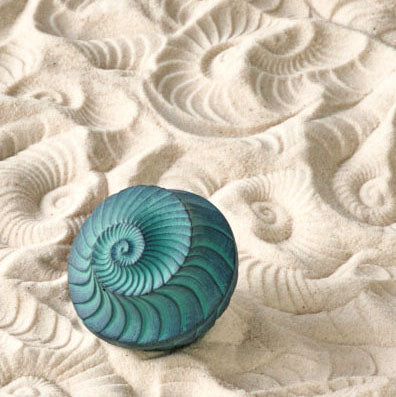
Round vs. rectangular. Wonderscapes have no corners, no frame, no constriction, just continuous free flow. There's something finite about a square frame, and infinite about the flow of a circular space.
Shallow vs. deep. Wonderscapes are much more shallow; a quarter inch of sand is as much as you need. It's about the design surface. Patterns transfer consistently in shallow sand. If the sand is too deep, patterns distort and cave into the middle of the path, creating dunes that overwhelm the subtlety and detail of the intended textures.
Coved inner rim vs. box wall. The inner cove creates the condition that spheres can touch the entire surface of sand. A straight wall limits contact, leaving a margin of inaccessible sand around the border.
Spheres vs. miniatures. Sand Spheres can be used as miniatures, but we intend for a Wonderscape to be its own sensory experience. If anyone chooses to create a hybrid setup, with Sand Spheres, miniatures or figurines, and nature objects intermingled, we support their creativity. But for the sake of distinction between our creations and sand tray or sandplay therapy, we hope to draw a line in the sand, so to speak.
Function
Time. Wonderscapes are there for however much time you care to fill: ten seconds on your way out the door, a few minutes to reset in peace, a ten minute call, a half hour Zoom, passive time shared with family and friends. There are no rules, general expectations, or outcomes of time spent with a Wonderscape.
Activity. Wonderscapes are art objects that provide free play and discovery, and a wellness tool that can help you gather yourself. They are not made for therapists to gather observations or behavior sets.
Movement and motion. Some customers and practitioners use Wonderscapes as tactile, screen-free objects for grounding rituals, creative play, and sensory engagement. What happens in one can be entirely different from another, based on the behavior of the participants, the collection of objects at hand, and the size of the tray.
Feeling
Wonderscape sand trays are what you bring into them. Your state of mind, your imagination, and your chosen curation of sphere designs and colorways all gather to create a unique experience. Where one person finds stress relief, another finds creative stimulation. Where one mind drifts to memories of far away places, another sinks into the visceral sensory satisfaction beneath their eyes and fingertips.
Practitioners of multiple therapy traditions have recognized the therapeutic value of our Wonderscapes. Sand tray therapy, by name, has the most obvious connection to what we offer. Here we hope to have made these contrasts clear.

Closing
Let’s return to the box of sand on the low table. The person still kneels beside it. The picture is more complete now. Across the room, the practitioner sits in her chair, notebook open, attention sustained. The sand is fine and pale, the tray painted blue underneath, the cabinet of small things within reach: animals, fences, tiny houses, a few people. The person chooses one. Considers it. Places it in the sand. The world has begun.
What began with children in post-war London now serves us all. The need for tactile, non-verbal processing is universal.
Sources
Boik, B. L., & Goodwin, E. A. (2000). Sandplay therapy: A step-by-step manual for psychotherapists of diverse orientations. W. W. Norton.
Bradway, K. (1985). Sandplay bridges and the transcendent function. C. G. Jung Institute of San Francisco.
Bradway, K., & McCoard, B. (1997). Sandplay: Silent workshop of the psyche. Routledge.
Carey, L. (1991). Family sandplay therapy. The Arts in Psychotherapy, 18(3), 231–239.
Carey, L. (2006). Expressive and creative arts methods for trauma survivors. Jessica Kingsley Publishers.
De Domenico, G. S. (1995). Sandtray world play: A comprehensive guide to the use of sandtray in psychotherapeutic and transformational settings. Vision Quest Images.
Homeyer, L. E., & Sweeney, D. S. (2017). Sandtray therapy: A practical manual (3rd ed.). Routledge.
Kalff, D. M. (1980). Sandplay: A psychotherapeutic approach to the psyche. Sigo Press.
Lowenfeld, M. (1979). The world technique. George Allen & Unwin.
Mitchell, R. R., & Friedman, H. S. (1994). Sandplay: Past, present and future. Routledge.
Weinrib, E. L. (1983). Images of the self: The sandplay therapy process. Sigo Press.
International Society for Sandplay Therapy. Founding history and clinical standards.